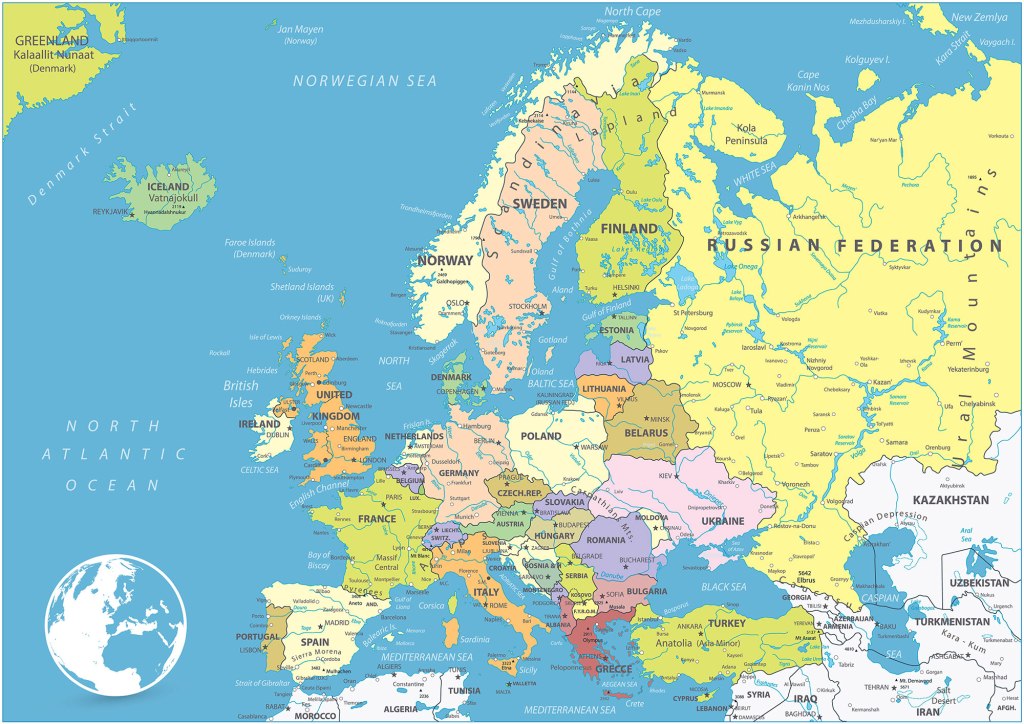
Featured map: https://gisgeography.com/europe-map/
A tale of the Schengen zone, what it is and how to deal with it
A European fantasy holiday
So, tickets booked for the UK (London), marking the starting point of our adventure. What comes next? I’ll be honest; we hit a bit of a delay, thinking we had all the time in the world to plan the rest of our trip, saying, “Oh, we’ll do it this day…” – which, inevitably, turned into “that day” and so forth. Eventually, though, we pulled ourselves together and crafted a rough guide of our journey. The skeleton, so to speak, with the flesh (more details – cool metaphor, I know) to be added closer to the time.
Now, the Schengen Zone – Jordan, hang in there; I’ll get to it. But first, let me share a mistake we made, so you don’t do the same. We initially planned to start in the UK, exploring England, Ireland, and Scotland before venturing into the rest of Europe for the remaining four months, with a brief detour into the Balkans. It seemed straightforward in the back of our minds – hanging out in the main European hotspots for most of our time, or so we thought…
Then, the handbrake slammed on. SCHENGEN ZONE. We were off with the fairies, thinking it would be straightforward. When we started planning this initial ‘fantasy,’ yeah, we saw the word Schengen mentioned on a few websites but dismissed it as an odd word that didn’t sound real, carrying on with our planning. Plot twist – it’s real, and thank goodness we decided to look into it when curiosity got the better of us.
The Schengen Zone is a rule implemented across most of Europe. See the map below to understand where it is enforced.

From the map above, you can observe that most of the well-known European hotspots (excluding the UK) constitute the Schengen Zone. This collective rule ensures that tourists can only stay within this zone for a certain amount of time. While it may seem stringent at face value, delving deeper into the rule reveals its logical foundation. The Schengen Zone facilitates seamless movement for residents, treating the entire zone as one large country with a single border. Consequently, tourists visiting this zone can easily traverse national borders without frequent stops—quite convenient if you’ve looked into it before traveling, isn’t it?
Visas for the Schengen Zone
Below is a table which sets out what countries do not require a visa to enter the Schengen Zone.
| Albania | Andorra | Antigua Barbuda | Argentina |
| Australia | Bahamas | Barbados | Bosnia & Herzegovina |
| Brazil | Brunei | Canada | Chile |
| Columbia | Costa Rica | Dominica | El Salvador |
| Georgia | Grenada | Guatemala | Vatican City |
| Honduras | Hong Kong | Israel | Japan |
| Kiribati | Macao | Malaysia | Marshall Islands |
| Mauritius | Mexico | Micronesia | Moldova |
| Monaco | Montenegro | Nauru | New Zealand |
| Nicaragua | North Macedonia | Palau | Panama |
| Paraguay | Peru | Saint Kitts & Nevis | Saint Lucia |
| Sain Vincent | Samoa | Serbia | Seychelles |
| Singapore | Solomon Islands | South Korea | Taiwan |
| Timor Leste | Tonga | Trinidad & Tobago | Tuvalu |
| Ukraine | UAE | USA | Uruguay |
| Vanuatu | Venezuela | United Kingdom |
If the country you are from is in bold, it’s because you guys are unique and hold a dear place in my heart… Well, some of you might, but unfortunately, it means there are a couple of extra hoops for you to jump through before entering the Schengen Zone (still without a visa, though). So, you’ll have to look into those finer details (thought I’d better give you some homework).
At the moment, these select countries enjoy visa-free entry into the Schengen Zone when following the 90/180 day rule (explained below). However, starting from the middle of 2025, these countries will require travellers to apply for travel authorisation. If you are planning to travel to the Schengen Zone around this time, take a cheeky look at the new rules coming into effect here.
90/180 Schengen Zone rule
Now that you have a better understanding of where the Schengen Zone is and why it exists, let’s delve into the rule that governs this zone – the 90/180 day rule. Here’s how it works: once you enter a country within the Schengen Zone, the clock starts ticking. You are allowed to stay in the Schengen Zone for a total of 90 days within any 180-day period. Once you’ve used up your 90 days, you must leave the Schengen Zone and refrain from re-entering until 180 days have passed from your initial entry.
I know it can be a bit confusing, so let’s iron out this rule with a couple of examples to help you wrap your noggin around it.
Example 1: Little Timmy enters the Schengen Zone and stays for 90 consecutive days. This means he has stayed 90 out of the past 180 days and must leave the Schengen Zone for the next 90 days before he can re-enter.
Example 2: Little Timmy decides to change tactics. This time, he stays for 20 days in the Schengen Zone and leaves for 30 days. He then returns to the Schengen Zone on day 50/180, having only used 20 days. Consequently, he can stay for an additional 70 days before he must leave the Schengen Zone on day 120/180, having exhausted his 90 days in the zone. Now, he can return to the zone in 60 days once the 180 days are up.
In conclusion, Little Timmy really loves the Schengen Zone.
How to stay longer in the Schengen Zone
Now, with this example in mind, you – yes, you, the one potentially feeling a bit bored reading this – might be wondering if there’s a way to extend your stay in this zone for more extensive travel. The answer is yes, but with a catch.
- First way – Bilateral agreements independent of Schengen Zone
- Second scary, dodgy, risky & spooky way – Only illegal if you get caught
The first way is through certain countries within this zone that have bilateral agreements. These agreements allow travellers, once they have spent their initial 90 days in the Schengen Zone, to stay for an extended period (up to an extra 90 days in some countries) within that specific country. However, there’s a catch: during your extended stay in the zone, you must remain within the borders of that one country and cannot cross back into the Schengen Zone if you plan to leave that selected country. It’s crucial to note that these extended stay rules in certain countries, such as France, do not reset the 90/180 day rule. Therefore, you will still need to leave the Schengen Zone as soon as your extended stay concludes. If you’re considering a longer stay, the best course of action is to check the specific rules that apply to your country, as regulations vary between different countries.
The second, more daring approach is appropriately named for what it is: scary, dodgy, risky, and spooky. I bring up this alternative to emphasise the risks associated with overstaying the 90-day limit. I strongly recommend using this Schengen Zone Calculator to avoid any unintentional overstay. However, be warned, this approach is entirely at your own risk, and I do not endorse it. For the risk takers, adrenaline junkies, and those who revel in the crazy and scary (no offence, cough cough), the idea is to stay past the 90 days and hope…
From my research, this is indeed an option, but it comes with significant risks. While a few individuals may get away with it, the majority do not. If you decide to test the waters and stay longer than allowed, what happens next? Well, if you’re found, you’ll face heavy fines and deportation from the Schengen Zone. In some cases, if the overstay is more than a few days, your passport might even receive an illegal immigrant stamp, making it incredibly challenging to return to the area in the future. Still game to try this method? If you do end up overstaying, when leaving, Greece, Italy, and Spain are your best bets for exiting the zone with nothing more than a slap on the wrist – as long as it’s not way past the 90 days. There you have it; I don’t recommend this at all, but for the spooky, scary people, well, there you go…

Our new plan with the Schengen Zone
Now that I’ve explained and laid out the Schengen Zone for you, let me share the bones of our travel plan, incorporating the Schengen Zone and how we plan to make the most out of it.
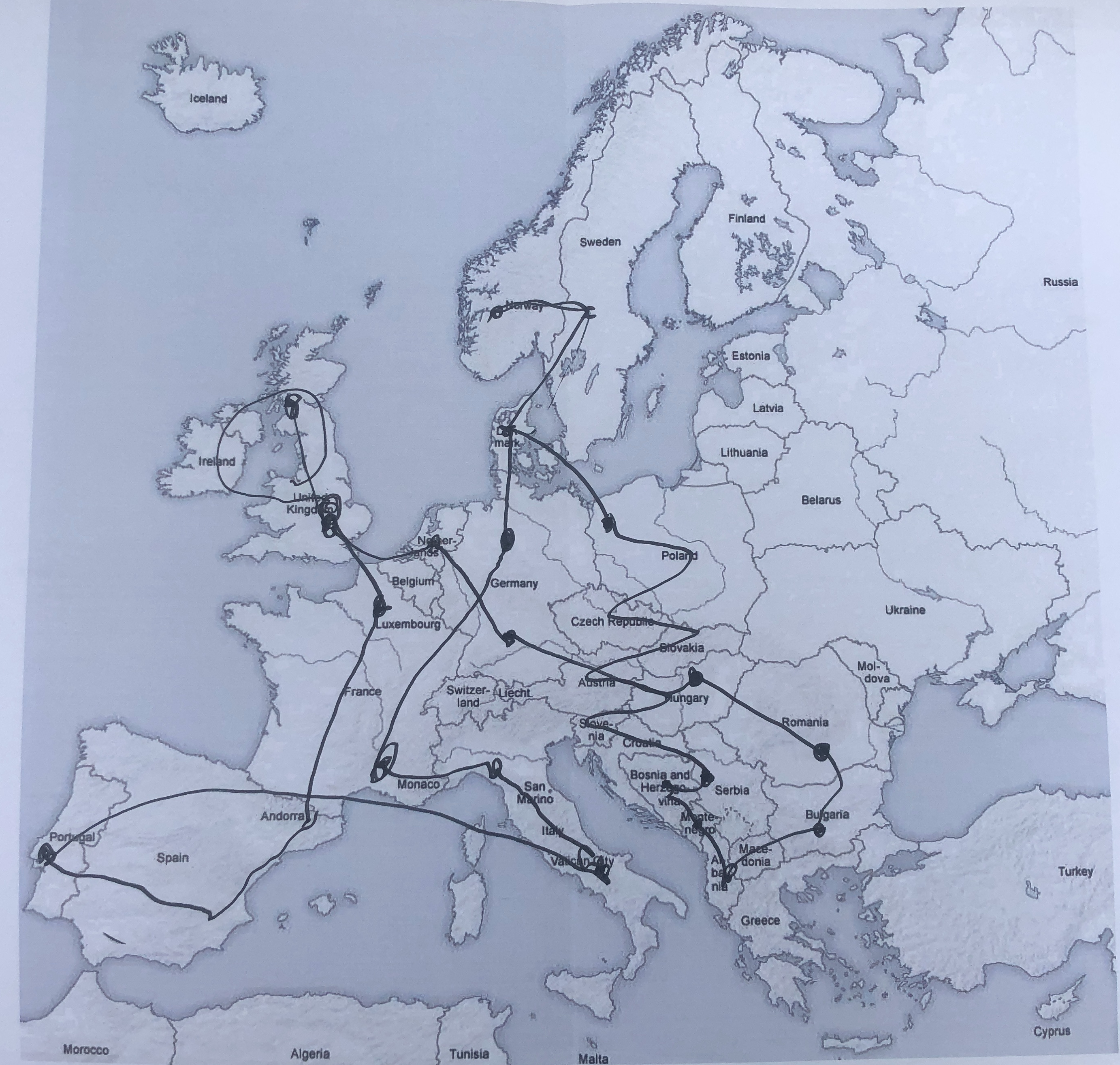
I bet those scribbles on the map may seem a bit confusing to you, or maybe you can piece them together somewhat. Either way, let me break it down a little more for you.
- England: 19th March – 2nd April
- Netherlands: 3rd – 6th April
- Germany: 7th – 9th April
- Hungary: 10th – 14th April
- Balkans / Turkey: 15th April – 20th May
- Eastern Europe: 21st May – 3rd June
- Scandinavia: 4th – 18th June
- Germany (Football Euros): 19th – 24th June
- France: 25th June – 1st July
- Italy: 2nd – 11th July
- Portugal / Spain: 12th – 25th July
- France (Paris Olympics): 26th -29th July
- UK: 30 July -onwards
This leaves us with roughly 2 weeks we can spend in the Schengen Zone. Around October 7th, the 90/180 day rule resets, allowing us to re-enter the Schengen Zone if we have used all the days.
These are rough dates and are subject to change, but they provide a basic framework for our travel planning. The dates can be adjusted, countries can be added or removed based on the rest of our planning, which is bound to see some changes. However, this gives a good starting point to work with.
Exploring the Balkans, although less of a tourist hotspot, offers incredible attractions, activities, and cultures at half the price of mainstream Europe, and it’s not part of the Schengen Zone. We added this part to our plan so we could align with the Schengen Zone dates we wanted. Personally, it has worked out better as diving deeper into the Balkans reveals an often-ignored gem of Europe, where you can spend more time as prices are more budget-friendly. So, I’d recommend considering this if you find yourself struggling with managing time within the Schengen Zone.
I’ll give your brain and eyes a rest for now (really just my own) and will dive into more detailed information about the countries I’ll be travelling to at a later point.

Now either read another one of my posts or go get some fresh air, and maybe even pick some flowers – you know, something like this lad (me) over here.
 Rural Lad Abroad
Leave a comment